Picking out the best Vertical Solar Tubes for buyers around the world isn’t just about comparing brightness specs. You’ve gotta think about things like your roof’s shape, the local climate, how skilled the installers are, and even the building codes where you’re putting these in. For example, a tube that works great in a dry Australian suburb might need a different flashing setup if you’re in a rainy coastal area—that little detail can really make a difference.
When you’re evaluating your options, don’t just look at light output or tube diameter. Make sure to check the diffuser quality, how well it transfers heat, what kind of warranty you’re getting, and how easy it is to get replacements if needed. Brands like Solatube and VELUX are usually trusted because they come with detailed specs and handy installation guides. But don’t just rely on brand names—ask for actual test data, certification papers, and clear maintenance instructions before you buy large quantities.
And don’t forget to really examine your roof before purchasing. For big projects—like commercial buildings, hospitals, warehouses, or even residential homes—installers should do a proper calculation of how much daylight the space needs rather than just trusting in showroom demos. A narrow hallway might only need one small tube, while a larger office could need several spaced out diffusers. If your interior has reflective surfaces, it can boost the light, but dusty or dirty environments might lower the performance over time. Also, consider logistics—packaging for shipping, customs paperwork, local service options, and whether spare parts are easy to find.
No single product or supplier is perfect. Someone with super-efficient optics might not offer much support in your country. And a cheaper model might look tempting, but if it doesn’t seal well, you could end up paying for repairs later. Ultimately, global buyers should look at the full picture—consider total ownership costs, not just the sticker price. The best choice is the one that offers proven performance, good practical support, and fits well with your local conditions and project needs.
Vertical Solar Tubes Defined: 250–550 mm Diameters and 90–99% Reflectance
Vertical Solar Tubes are light-guiding systems designed for roofs, shafts, and interior spaces where windows are impractical. Global buyers often compare tubes between 250 and 550 mm in diameter. The diameter affects daylight delivery, roof loading, transport size, and installation access. A 250 mm tube may suit a corridor or small bathroom. A 550 mm model can serve larger rooms, but it needs stronger structural planning.
Reflectance ratings usually range from 90% to 99%. Higher reflectance can preserve more daylight through long or angled tubes. Yet the number alone is not enough. Ask how reflectance was tested, at which wavelength, and after what surface treatment. A bright tube may still perform poorly if its diffuser scatters light unevenly. Dust, condensation, and repeated cleaning can also reduce real-world output. Small details matter.
For buyers searching CE Certification Vertical Solar Tubes, request traceable test reports and applicable conformity documents. CE marking should match the product’s relevant European requirements; it is not a universal quality guarantee. Check tube length, flashing materials, fire performance, thermal behavior, and replacement parts before ordering. Roof pitch matters too. An experienced installer should inspect local weather, insulation thickness, and interior ceiling height. In practice, specifications can look perfect on paper. They may disappoint under a cloudy sky.
How Solar-Tube Efficiency Is Measured Under EN 410 and ISO 8995-1
For global buyers, vertical solar tubes should be judged through measured daylight performance, not marketing claims. EN 410:2011 calculates glazing properties, including visible transmittance, solar factor, and spectral response. These values help estimate how sunlight passes through a dome, shaft, and diffuser. However, EN 410 was designed mainly for building glass. A solar tube often needs additional testing for its reflective shaft and optical losses.
ISO 8995-1 focuses on indoor lighting quality and recommended illuminance, rather than product efficiency. Many office tasks require about 500 lux, while corridors commonly require around 100 lux. A useful assessment records illuminance at desk height, across several points, under stated sky conditions. Measure glare, uniformity, and color rendering too. One bright spot is not enough.
The International Energy Agency reports that buildings use about 30% of global energy and create roughly 26% of energy-related emissions (IEA, Buildings 2023). This supports daylight strategies, but savings depend on controls and occupancy. A tube can perform well in a laboratory and disappoint beneath a dusty roof. It happens. Buyers should request EN 410-related optical data, ISO 8995-1 lighting calculations, seasonal simulations, and independent field results. Testing at noon alone can mislead. A cloudy morning may reveal the real weakness.
Top Vertical Tube Types by Roof Pitch, Climate Zone, and Building Use
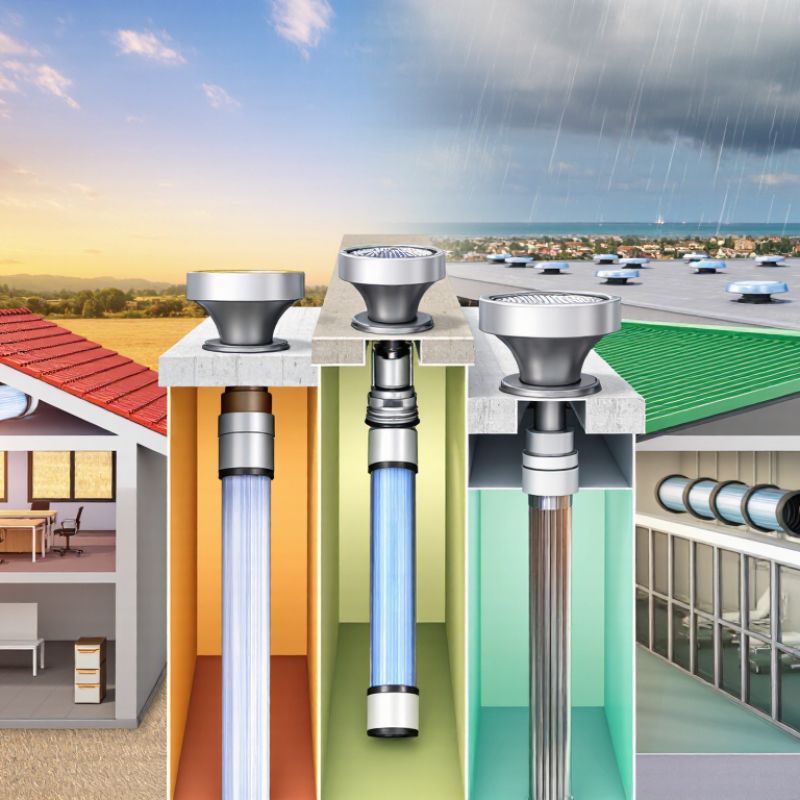
Vertical solar tubes should match roof pitch, local weather, and the building’s daily use. Low-slope roofs often need raised, curb-mounted tubes with dependable drainage details. Steep roofs usually suit flashing systems designed for angled tiles or metal panels. A poor angle can create shadows, leaks, or weak daylight distribution.
Climate changes the specification. In hot regions, choose diffusers with glare control and insulation around the tube. Snowy areas need strong flashing, snow-shedding placement, and careful load assessment. Coastal buildings require corrosion-resistant fittings and frequent inspection. Humid climates may expose condensation problems if the shaft is poorly sealed. Small commercial spaces may need wider tubes for corridors, workshops, or retail aisles. Homes often benefit from smaller units in bathrooms, stairwells, and windowless kitchens.
Tips: Ask Vertical Solar Tubes Manufacturers for roof-pitch drawings, climate testing, and installation tolerances. Measure the ceiling height before selecting tube length. Check the diffuser’s light spread, not only its diameter. I would not trust a low price without reviewing flashing details and warranty terms. One overlooked issue is maintenance access. It matters. Field experience shows that even a well-designed tube can disappoint when nearby vents, trees, or rooftop equipment block sunlight. Product data helps, but an on-site assessment remains more reliable.
Comparing Daylight Output: 300–600 mm Tubes for 10–40 m² Rooms
What Are the Top Vertical Solar Tubes for Global Buyers?
For 10–40 m² rooms, tube diameter strongly affects daylight delivery. A 300 mm vertical tube suits bedrooms, corridors, and compact offices. It can create a clear daylight patch near the diffuser. A 400 mm tube gives broader illumination for medium-sized rooms. In larger kitchens or studios, a 500–600 mm tube usually performs better. Bigger is not always better.
Roof exposure matters more than catalog figures. A clear south-facing roof in the northern hemisphere may provide stronger midday light. In tropical regions, cloud cover and roof heat need closer attention. A 300 mm tube may feel adequate beside a window, but weak in a deep room. Reflective shafts, sealed flashings, and clean diffusers can improve practical output. High-Quality Vertical Solar Tubes still need careful installation.
During site assessments, I compare the darkest corner, not the brightest spot. This gives a more honest result. Light output can change sharply on cloudy days. That limitation is easy to overlook. For a 10–20 m² room, one 300–400 mm tube may work well. A 20–40 m² space may need a 500–600 mm model or multiple smaller tubes. Ceiling height, shaft length, interior colors, and diffuser position also influence comfort. I would avoid promising identical performance across countries, because local skies and installation quality vary.
What Are the Top Vertical Solar Tubes for Global Buyers?
Comparing daylight output from 300–600 mm vertical solar tubes for rooms measuring approximately 10–40 m²
*Indicative engineering ranges for a vertical, roof-mounted daylight tube under bright daytime conditions. Actual output varies with latitude, season, cloud cover, roof orientation, roof shading, shaft length, shaft reflectance, diffuser transmission, ceiling height and interior surface reflectance. For a detailed design, verify daylight performance using local climate data and a room-specific lighting calculation.
Weatherproofing Standards: IP Ratings, UV Resistance, and Wind Loads
For global buyers, vertical solar tubes must handle more than bright daylight. Their weatherproofing affects service life, indoor comfort, and maintenance costs. Start with the IP rating. An IP65 enclosure resists dust and water jets, while IP67 offers temporary immersion protection. These ratings apply to tested components, not automatically to the whole roof assembly. That distinction matters. A qualified Vertical Solar Tubes Manufacturer should provide test reports, gasket details, and installation limits.
UV resistance deserves equal attention in intense climates. Tubes, seals, flashing, and diffusers can age at different rates under constant sunlight. Ask for accelerated UV testing and material data for every exposed part. A clear diffuser may stay bright but become brittle. I have seen this overlooked during purchasing reviews. It looked acceptable at handover. Two hot seasons later, the seal needed replacement. Maybe the original inspection was too optimistic.
Wind loads must match the building site, roof height, and tube projection. Coastal roofs, open farmland, and cyclone-prone regions require careful structural calculations. Request pressure and uplift test values, fastener specifications, and spacing diagrams. Do not trust a generic “high wind” label. An engineer should verify the roof substrate, flashing, and nearby obstructions. Also check temperature cycling and rain penetration tests. Small paperwork gaps can become wet ceiling stains. Choose documentation that local installers can understand and apply.
Top Vertical Solar Tubes for Global Buyers: Weatherproofing Benchmarks
A practical comparison of internationally recognized enclosure ratings, UV test methods, and reference wind pressures for outdoor vertical solar tube installations.
IP65–IP66 Common high-protection benchmarks under IEC 60529: dust-tight, with protection against water jets. IP66 provides stronger water-jet protection than IP65.
UV Resistance ISO 4892-2 and ASTM G154 are recognized accelerated UV-aging methods. Buyers should request exposure conditions and post-test performance, not only a UV label.
Wind Loads Reference pressures are calculated with q = 0.613V², where V is wind speed in m/s. Final design loads must follow the applicable local building code and installation geometry.
Note: Wind-pressure values are reference calculations, not product certifications. IP ratings describe enclosure ingress protection and do not by themselves verify structural wind resistance or UV durability.
Global Buyer Checklist: U-value, Solar Heat Gain, Warranty, and Compliance
What Are the Top Vertical Solar Tubes for Global Buyers?
A strong vertical solar tube should be judged by tested performance, not brightness alone. The IEA Buildings 2023 report estimates that buildings consume about 30% of global final energy. This makes heat transfer worth checking carefully. Ask for the complete U-value, including the tube, dome, diffuser, and flashing. Lower U-values generally reduce conductive heat loss. However, the best target depends on climate and roof construction. A cold-region project may need performance near high-quality skylight standards, while a hot region may prioritize solar control.
Solar heat gain coefficient also matters. A low SHGC can reduce summer overheating, but it may waste useful winter sunlight in colder regions. Small rooms reveal weak designs quickly. Watch the ceiling diffuser at noon, then inspect condensation after a cold night. The numbers should match real conditions. NFRC rating procedures provide a useful reference for U-factor and SHGC, while ASHRAE 90.1 offers climate-based fenestration guidance. Still, some suppliers provide incomplete test boundaries. That is a serious gap.
Warranty language deserves equal attention. Look for separate coverage periods for the dome, reflective tube, seal, flashing, and interior diffuser. Confirm who pays for roof access and replacement labor. Compliance documents should address wind, snow, fire, moisture, and local electrical requirements where applicable. European projects may require construction-product documentation, while other markets follow different testing routes. A certificate without a matching product code is weak evidence. Recheck it.
FAQS
They guide daylight through roofs, shafts, and interior spaces without practical windows. A 250 mm tube may suit a corridor or small bathroom. Larger rooms may need wider tubes. Not always.
Diameters commonly range from 250 to 550 mm. Wider tubes can deliver more daylight, but they increase roof loading and installation difficulty. Transport access matters too.
Reflectance indicates how much light the inner surface redirects through the tube. Higher reflectance may help in long or angled shafts. The percentage alone proves little.
Ask for traceable test reports, test wavelengths, and surface-treatment details. Check whether measurements reflect new materials or aged surfaces. Dust and repeated cleaning can reduce output.
Measure illuminance at desk height across several indoor points. Record sky conditions, glare, uniformity, and color rendering. One bright patch is not enough.
EN 410 helps assess visible transmittance, solar factors, and spectral response. ISO 8995-1 supports indoor lighting-quality and illuminance assessments. A solar tube may require additional shaft and diffuser testing.
Office tasks often require about 500 lux. Corridors commonly require around 100 lux. Actual needs depend on tasks, room layout, and occupant comfort.
Inspect roof pitch, weather exposure, insulation thickness, and ceiling height. Confirm flashing materials, fire performance, thermal behavior, tube length, and replacement parts. A strong specification can still disappoint under cloudy skies.
Conclusion
Vertical Solar Tubes are daylighting systems designed to channel natural light from rooftops into interior spaces through highly reflective vertical shafts. Common diameters range from 250 to 550 mm, with reflectance levels of approximately 90–99%. Their performance can be assessed using recognized methods such as EN 410 for solar and light transmission characteristics and ISO 8995-1 for interior lighting requirements. Selecting the right tube depends on roof pitch, climate conditions, room size, and building use. For rooms measuring 10–40 m², tubes between 300 and 600 mm may provide practical daylight output when correctly positioned and installed.
Global buyers should also evaluate weatherproofing and long-term reliability. Important factors include IP protection, UV-resistant materials, resistance to wind loads, thermal U-value, solar heat gain, warranty coverage, and compliance with applicable regional standards. A suitable product should balance brightness, heat control, durability, and installation requirements while matching the building’s roof structure and local climate.